On this page
Key takeaways
- For trips between Madrid-Barajas Airport and addresses inside the M-30, the official taxi fare is 33 euros, 24 hours a day, with no extra supplement.
- Street taxis are often the fastest answer on main roads. At the airport, Atocha, Chamartin, and bus stations, use the official taxi rank.
- Uber is not automatically cheaper in Madrid. Compare the actual quotes and conditions from taxi apps, Bolt, Cabify and Uber; no app is consistently the cheapest for every trip.
You will not think about Madrid taxis until it is midnight, raining, and you have just left a restaurant in Lavapies with no obvious cab on the street.
Worth knowing before that happens: Uber is not automatically the answer in Madrid. It is not even automatically the cheap answer. FreeNow connects passengers with official taxis, but the quote, service type and conditions still need checking; that does not make it universally cheaper. Bolt and Cabify are also normal options. And sometimes the best move is still the old one: step to a main road, look for the green light, and raise your hand.
Madrid is not difficult by taxi. It is difficult only if you assume the app you already know is the city.
The Airport Rule
For most people, the first taxi decision in Madrid happens at Barajas with a suitcase in one hand and a phone battery that is starting to make threats.
The official fixed taxi fare between Adolfo Suarez Madrid-Barajas Airport and any address inside the M-30 ring road is 33 euros. It applies 24 hours a day, every day of the year, in both directions. There is no extra charge for luggage, night service, holidays, or a booking supplement when this fixed airport tariff applies.
That one sentence saves people money. It covers the central Madrid most new arrivals mean when they say "the city": Sol, Gran Via, Malasana, Chueca, Chamberi, Salamanca, Retiro, La Latina, Lavapies, Arganzuela, Atocha, and the usual first-month zones inside the ring.
The catch is the M-30. Madrid people use it as a mental boundary, but newcomers often do not know whether their flat is inside it. If your destination is outside the M-30, the 33 euro fixed fare may not apply. For airport trips from the terminal taxi ranks to destinations outside the M-30 with a short route under 9 km, the official airport minimum is 22 euros, then the meter continues after that threshold. For longer suburban trips, ask or check before assuming the magic number follows you.
At the airport, the taxi rank is usually the cleanest choice for a central address. The queue at T4 can look long on a Sunday morning and still move faster than an app driver trying to explain which VTC pickup lane they are in. Uber, Bolt, and Cabify can make sense if you want a specific vehicle, a reservation, or a destination where the taxi fixed fare is not helpful. But for central Madrid, 33 euros is the benchmark. If an app is showing more, it needs to earn the difference.
Street Taxis Are Not A Tourist Trick
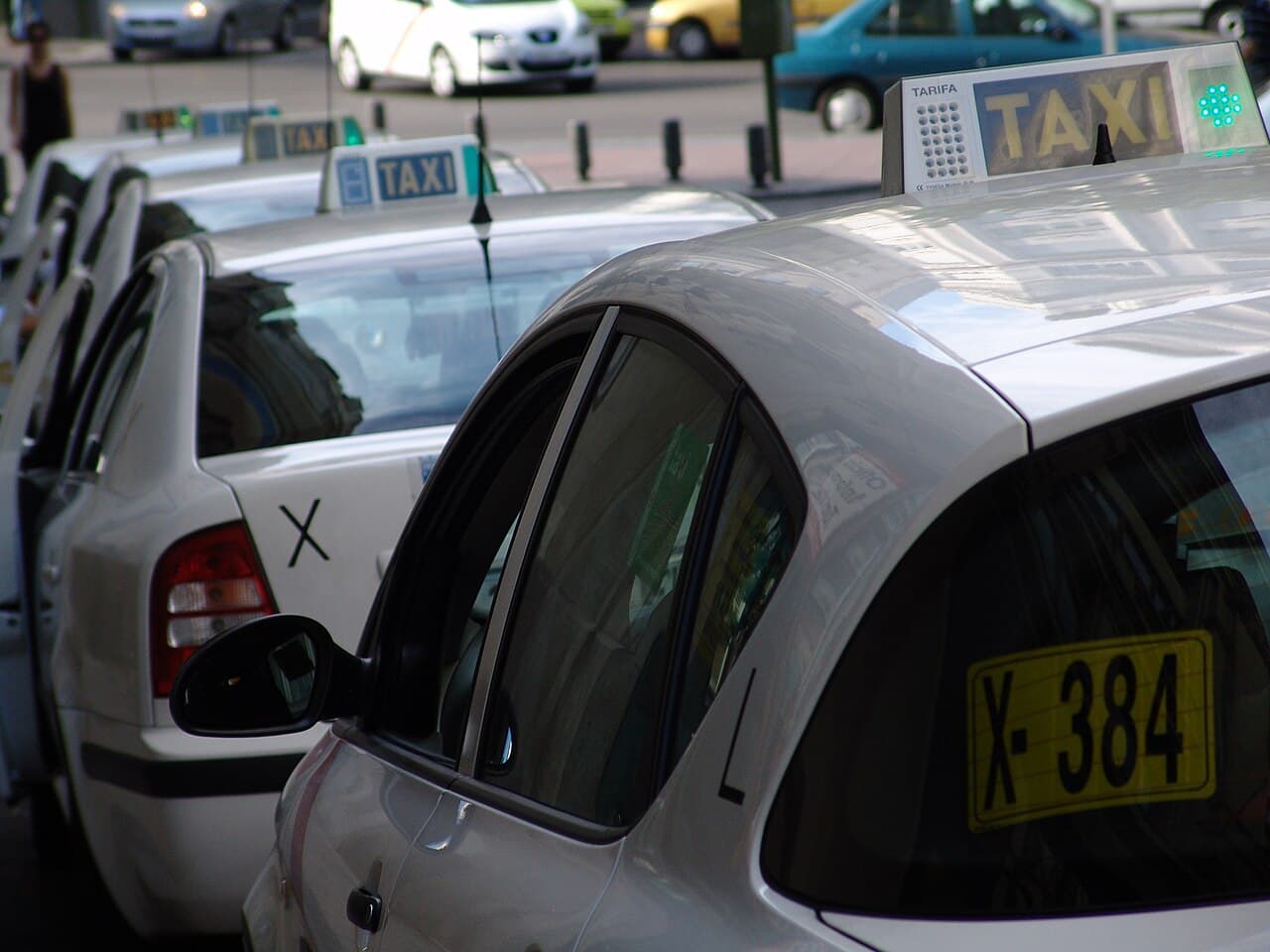
Official Madrid taxis are white with a red diagonal stripe and the city emblem on the door. If the green roof light is on, the taxi is free. You raise your hand. The driver stops if the street allows it. No drama, no app, no animated car icon pretending to be one minute away for six minutes.
This works best on main roads and around busy areas: Gran Via, Castellana, Goya, Princesa, Atocha, large hotel streets, restaurant areas after dinner. It works less well on quiet residential corners where no taxi has a reason to pass. Madrid is dense, but taxis still follow traffic and money.
The thing newcomers miss is that street hailing often beats app waiting. If you are already on a broad avenue and three white taxis pass in a minute, opening Uber can be the slow option. You may end up watching a driver circle the wrong block while the obvious cab goes past with its green light on.
You do not need fluent Spanish for ordinary taxi trips. Say the address, show it on your phone, or name the nearest landmark. Most rides are not conversations; they are logistics. The meter does the complicated part.
Taxi Ranks Matter More Than Apps At Stations
Madrid has taxi ranks all over the city, marked with a blue sign and a white T. They matter most at places where pickup points get messy: Barajas, Atocha, Chamartin, Avenida de America, Mendez Alvaro, hospitals, big hotels, IFEMA, and event venues.
At the airport and major stations, use the official rank unless you have a very specific reason not to. Do not follow anyone inside a terminal offering a private ride. Madrid is not a city where you need to improvise airport transport with a stranger. The regulated option is standing outside with a queue, a sign, and a price structure.
The rank is not always charming. There may be a line, a tired family in front of you, and someone trying to fit too many suitcases into a normal car. Still, it is often more predictable than asking an app driver to find you on the wrong side of Atocha.
FreeNow Is Often The Quiet Winner
FreeNow deserves more attention than most newcomers give it. In Madrid, it usually connects you with official taxis, which means you get the app layer without leaving the taxi system entirely. You can pay in the app, see the driver, keep a trip record, and sometimes choose a fixed price.
The important bit: FreeNow often comes out cheaper than Uber for the same route. Not always. Not by law. Not because one app is morally pure and the other is plotting against your dinner budget. Just often enough that it is silly not to check.
This matters most when Uber is busy. Rain, late dinners, concerts, transport disruptions, and airport peaks can all make app prices stretch. A FreeNow taxi price may sit closer to normal taxi reality while Uber is behaving like everyone in Madrid suddenly needs to cross town at once.
FreeNow is still an app. Drivers can cancel. Pickup pins can be awkward. Waiting three minutes can become eight. But if your default habit is opening Uber first and stopping there, you are probably overpaying some of the time.
Uber, Bolt, And Cabify Are Options, Not Defaults
Uber, Bolt, and Cabify all have a place in Madrid. They are useful when you want an upfront price, app tracking, a reservation, a particular vehicle type, or a pickup where taxis are unlikely to pass. Cabify is especially worth remembering because it is a Spanish-founded app and a normal part of the local VTC landscape, not some niche side option.
At the airport, Uber, Bolt, and Cabify pickups generally mean VTC pickup areas rather than the official taxi rank, unless you have selected a taxi category inside the app where available. That can be fine. It can also mean following signs through a car park while the taxi queue you ignored moves steadily outside arrivals.
The tradeoff is price and pickup friction. On a quiet afternoon, Bolt or Cabify may be excellent value. Uber may be perfectly sensible. On a rainy Friday night after dinner, any of them can become expensive enough that a normal taxi or FreeNow looks better. The brand is less important than the number on the screen and the place where the driver can actually collect you.
The practical Madrid habit is not "use Uber." It is compare. Open FreeNow, Uber, Bolt, and Cabify if price matters. If you are near a taxi rank or standing on a main road with green lights passing, compare that too. Madrid rewards people who are mildly disloyal to apps.
Reader Codes
This article is not sponsored. The links below are referral links: you may receive a first-trip discount, and The Madrid Dispatch may receive a small referral credit if you use them. They do not change the advice in this guide. Always compare FreeNow, Uber, Bolt, Cabify, and the official taxi option before booking.
For FreeNow, use referral code hgjiwzrls for 50 percent off your first trip, up to 6 euros. If you do not have the app yet, you can use this FreeNow referral link: download FreeNow.
For Uber, this referral link offers 20 euros off your first five Uber trips: try Uber rides.
Do Not Ignore TXMAD
TXMAD is the official taxi app from the Ayuntamiento de Madrid. It is not the app most people will instinctively open for every ride, but it is useful because it comes from the city rather than a private platform.
Its value is practical information: official tariffs, fare estimates, taxi ranks, lost-property help, safety information, and complaint routes. If something feels off, or you simply want to understand what the regulated taxi system says should happen, TXMAD is worth having in the background.
Think of it less as your nightlife ride app and more as the official reference when Madrid taxi rules start to matter.
Before You Go
Card payment is completely normal in Madrid taxis; almost no driver will fuss if you prefer cash either. If you do pay cash, small notes make life easier.
Tipping is not expected the way it is in the United States. Round up if you want to. Do not build a percentage calculation in your head unless that is your personal hobby.
If you are travelling with small children and need a child seat, book ahead and request it clearly. Do not assume every taxi or VTC will have one. If you leave something behind, an app trip is easier to trace. In a street taxi, keep the receipt when you can, because it gives you identifying details instead of a vague memory of a white car at 1am.
The Verdict
For Barajas to central Madrid, the official taxi fare is the baseline: 33 euros inside the M-30. A ride app showing more than that may still be worth it for convenience, but it should not win by default.
For normal city rides, the answer depends on the street you are standing on. On a busy avenue, a green-light taxi may beat every app on your phone. At the airport, Atocha, Chamartin, and bus stations, the rank is usually the sensible first move. Late at night, in rain, or from an awkward pickup point, apps become more valuable.
The only bad Madrid taxi strategy is loyalty. Compare FreeNow, Uber, Bolt, and Cabify. Notice the taxi rank. Watch the street. Then choose the option that is actually fastest, cleanest, and fairly priced for the ride in front of you.
Main tradeoffs
- Apps give price visibility and tracking, but the pickup point can be more annoying than the ride, especially at stations and airport terminals.
- Street taxis are simple when one is passing, but less useful on quiet residential streets or when you need a record of the trip.
- The 33 euro airport taxi fare is a strong benchmark, but it only applies between Barajas and addresses inside the M-30.
Sources
- Taxi fares from 1 January 2026 / Ayuntamiento de Madrid
- Getting around Madrid by taxi / Official Madrid tourism website
- TXMAD official taxi app / Ayuntamiento de Madrid
- Fixed price taxi in Madrid / FreeNow
- Madrid Airport pickup / Uber
- Madrid Airport transfers / Bolt
- Madrid fare table / Cabify
- Meeting points at Madrid airport / Cabify
Spotted an outdated detail? Send the desk a correction.