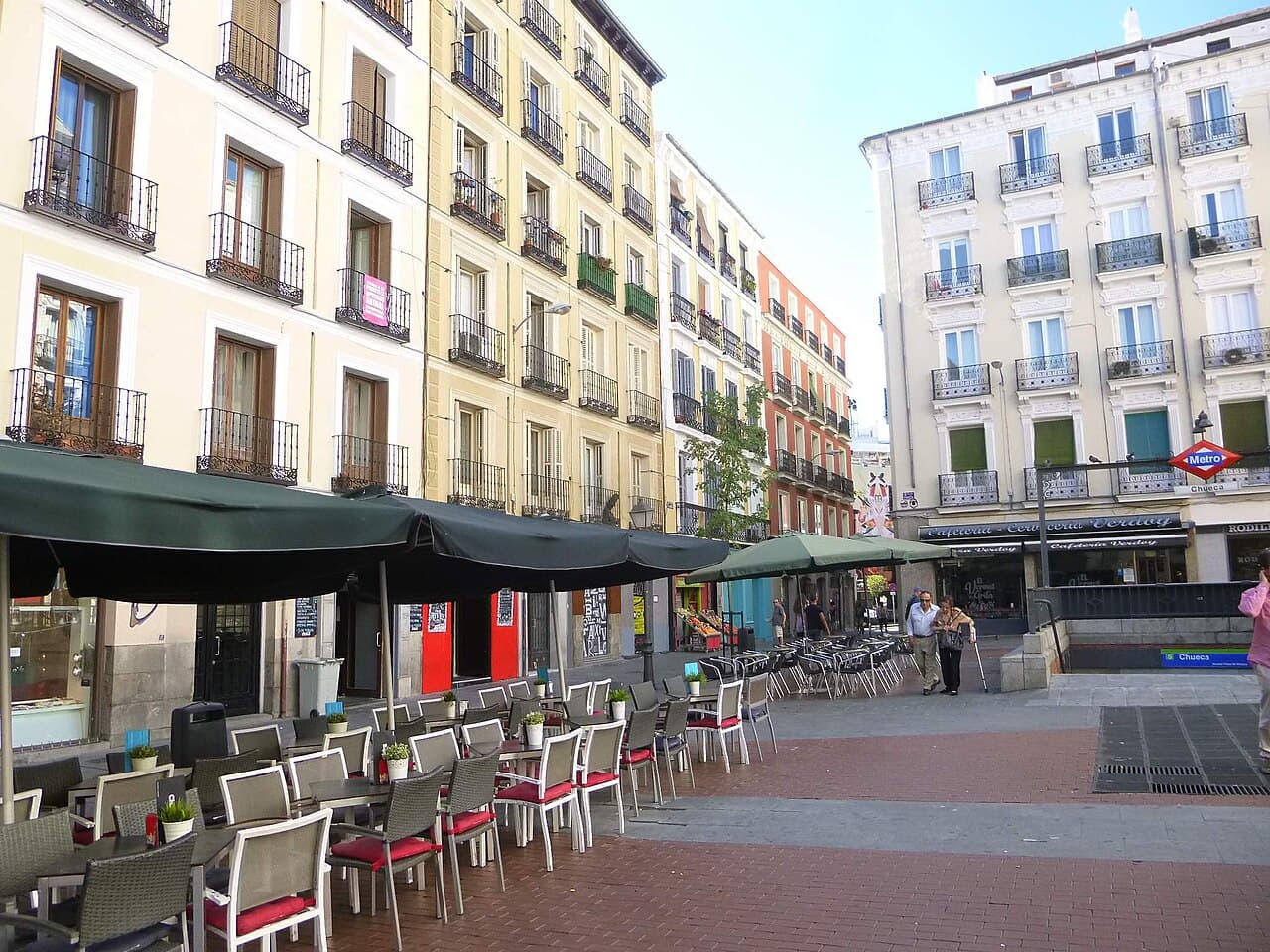
Quick snapshot
Best if you want central social life, restaurants, and LGBTQ-friendly energy more than quiet or space.
- Rent
- €€€€
- Typical rent
- €1,700–€3,000+
- Noise
- High
- Safety (editorial)
- High
- Green space
- Low
Rent & Cost of Living
Typical asking rent range: €1,700–€3,000+, varies by size, condition, and contract type. This edition's indicative per-square-metre estimate is around €29–€30/m² in Chueca-Justicia.
Rent ranges are dated editorial planning estimates, not current market quotations. Compare live listings and the exact flat. Atmosphere and safety ratings are editorial judgments, not statistical crime rankings.
A bit of history
Chueca is named after Federico Chueca, the 19th-century Madrid composer best known for the zarzuela La Gran Vía, but the neighbourhood's modern identity has almost nothing to do with him. For much of the 20th century the area was a neglected, run-down part of central Madrid associated with petty crime and drug activity — a decline that accelerated under the restrictions of the Franco years. The transformation began in the 1980s and 1990s when LGBTQ residents, artists, and small businesses moved into cheap premises and began reshaping the neighbourhood's character. The process was not planned — it was driven by affordability and by a community that wanted visible space in the city. By the mid-1990s Chueca had become Madrid's most recognisable LGBTQ neighbourhood and one of Europe's most inclusive. World Pride was held here in 2017. The infrastructure of bars, community venues, health services, bookshops, and organisations that built up during that transformation is still the skeleton of the neighbourhood today, now layered over with boutiques, brunch restaurants, and premium rents that would have been unimaginable in the barrio of thirty years ago.
The Vibe
Stylish, social, open, restaurant-heavy, nightlife-adjacent. Excellent central access via Chueca, Gran Via, Banco de España, Tribunal, Alonso Martinez, and walkable links to Malasana, Salesas, Sol, and Salamanca.
Chueca is one of Madrid's clearest lifestyle choices. It is central, stylish, social, restaurant-heavy, openly LGBTQ-friendly, and easy to use from day one. If you want a neighborhood where dinner, drinks, shopping, metro access, and spontaneous plans are all close, Chueca makes immediate sense.
That convenience is why it is expensive. Chueca-Justicia sits among Madrid's highest-rent central areas, and the premium does not always buy space. Many flats are compact, older, and priced for location more than comfort. A good apartment here is valuable because it combines central access with enough insulation, light, and distance from the loudest streets.
Who It’s For
- LGBTQ-friendly central life
- Restaurants and bars
- Social newcomers
- Short-to-medium stays
Who Should Avoid It
- You need quiet sleep
- You want more space for the rent
- You dislike weekend crowds
- You want a family-first routine
Best Sub-Areas
Highlights
- Plaza de Chueca and the surrounding LGBTQ nightlife scene
- Strong restaurant, cocktail, brunch, and boutique density
- Easy walking access to Gran Via, Malasana, Salesas, Sol, and Retiro edges
- One of Madrid's most internationally legible central neighborhoods
- Excellent metro and bus access without needing a car
Pros and Cons
Pros
- Extremely central and easy to understand as a newcomer
- Strong LGBTQ-friendly identity and social energy
- Excellent restaurants, bars, shops, and daily services
- Good for short stays and people who want instant city access
- More polished and comfortable than some other nightlife-heavy central areas
Cons
- Very expensive for small flats
- Nightlife and weekend noise can dominate exact streets
- Weak green space and limited calm outdoor routine
- Tourist, shopping, and nightlife pressure can make errands feel less local
- Not ideal for families, light sleepers, or car-dependent routines
Compared With Other Neighborhoods
- More polished and LGBTQ-coded than Malasana, but often just as noisy
- More social and central than Chamberi, with less weekday calm
- More expensive and comfortable than Lavapies, with less diversity of street texture
- More livable than Sol for many people, but still intense
Bottom Line
The neighborhood is not uniform. Around Plaza de Chueca, the identity is strongest: bars, terraces, LGBTQ nightlife, and a steady movement of people. Toward Justicia and Salesas, streets become more polished, boutique-driven, and sometimes calmer, though still expensive. Near Gran Via, convenience is unmatched but visitor pressure is high. Toward Banco de España and Barquillo, the area can feel more connected to museums, offices, and Salamanca.
Chueca works best for people who actively want central energy. It suits social newcomers, LGBTQ readers who want visible community, food lovers, short-stay residents, and people who prefer walking to planning. It is less ideal if you need sleep reliability, larger flats, green space, parking, or a family-first routine.
The smart way to judge Chueca is by exact street, floor, orientation, and windows. An interior-facing flat on a quieter side street can be an excellent central base. A first-floor exterior flat above a bar route can turn the same neighborhood into a bad decision. Choose Chueca for social access and identity. Do not choose it expecting Chamberi-style routine.
Location
Rent figures in this guide are editorial planning estimates from its 2026-05-02 edition, not a current market quotation or a guarantee for a particular flat. Compare live listings. Descriptions of atmosphere and safety are editorial judgments, not a statistical crime ranking; inspect the exact street and building.
Spotted an outdated detail? Send the desk a correction.